The technical article by Korea Register of Shipping (KR), titled "The Necessity and Demonstration Case of Physical AI Robot Technology for Smart Ships," introduced a shipboard demonstration case using a quadruped robot and TeamGRIT's robot control technology. This contribution examined the need for physical AI robot technology in the context of digital transformation and automation trends in the shipping and shipbuilding industries, highlighting future applicability and technical challenges through robot technology demonstrations conducted in actual ship environments.
Why Physical AI Robots Are Needed in Smart Ships
Existing smart ship technologies have advanced primarily to support navigation and maintenance based on sensors, communications, artificial intelligence, and data analysis. However, actual ships contain complex structures, narrow passages, and areas with limited worker access. In such environments, technologies capable not only of information analysis but also of direct movement, environmental perception, and physical task execution are required. Physical AI robots are attracting attention as technologies that can complement these spatial constraints and support inspection, safety management, and various tasks within ships.
Applicability of Robot Technology Verified in Actual Ship Environments
In the demonstration of a quadruped robot within a ship conducted by Korea Register of Shipping, K-Shipyard, and TeamGRIT, technologies such as SLAM-based spatial recognition, autonomous navigation, obstacle avoidance, and real-time monitoring were tested on deck and in the engine room. The article presented this demonstration as a case confirming the potential for robots to perceive their surroundings, navigate, and collect on-site information even in the complex spatial structures of real ships. At the same time, it identified future technical challenges to be addressed, including location recognition errors in repetitive and similar ship environments, communication conditions, battery life, and operational stability of robots under ship navigation conditions.
Towards the Application of Physical AI in the Shipbuilding and Maritime Industry
Based on its experience with onboard robot demonstrations, TeamGRIT is advancing technologies in spatial recognition, autonomous navigation, remote control, and data utilization. By developing robot operation technologies adaptable to diverse ship environments and intelligent inspection and task support technologies leveraging collected field data, TeamGRIT aims to expand the applicability of physical AI in the shipbuilding and maritime sectors.
K-Shipyard and Korea Register of Shipping Quadruped Robot Demonstration
What TeamGRIT Applied and Verified
Lim Jung-gyu, Senior Researcher at Korea Register of Shipping, "The Necessity and Demonstration Case of Physical AI Robot Technology for Smart Ships," KOSME Webzine, January 2026.
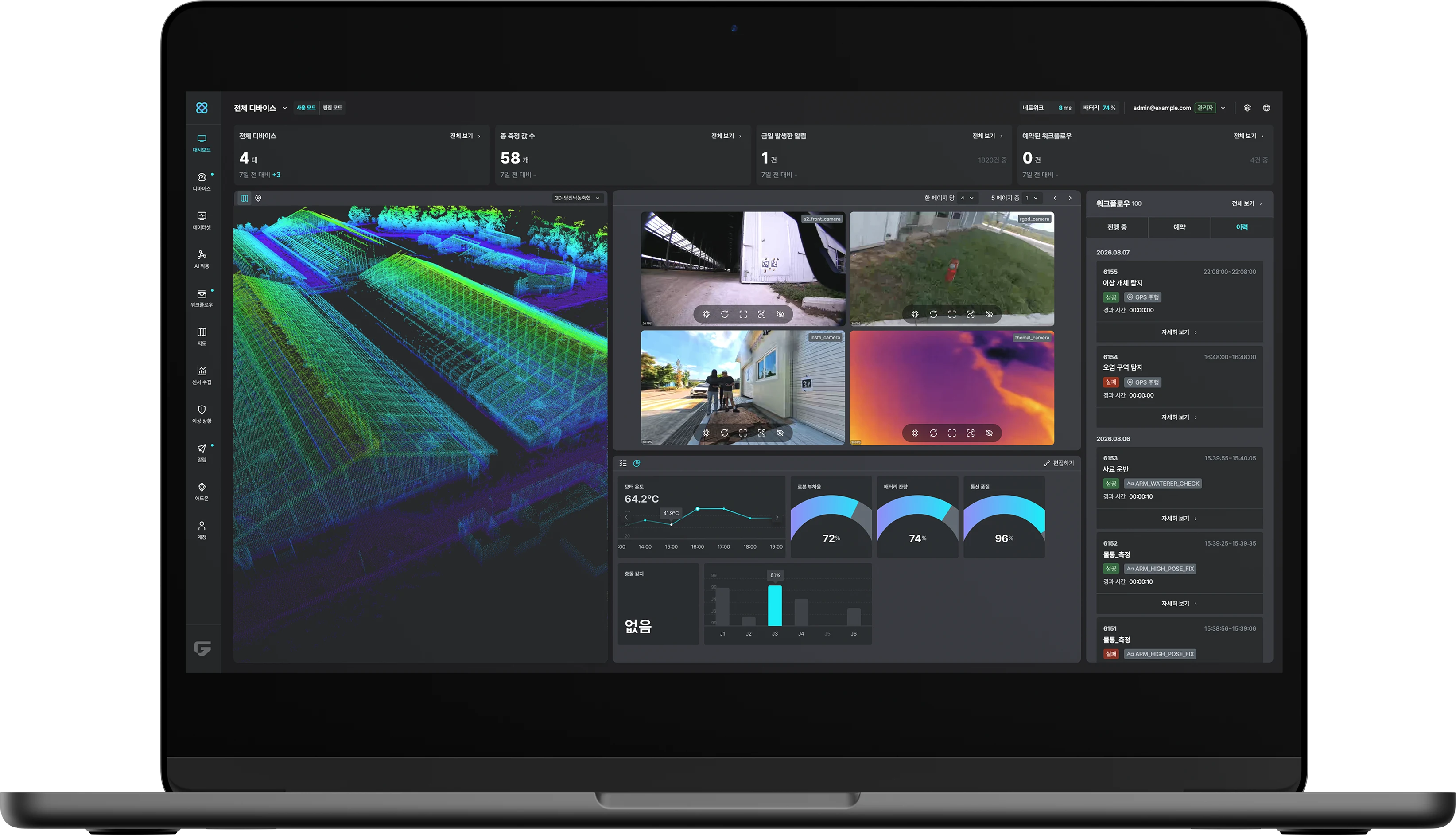
Connect robots and sensors and manage real-time monitoring, autonomous work, operational recording and replay, AI, and incident response in one platform.